


A denied applicant rarely knows why an algorithm made its decision. What they know is how it felt: confusing, inconsistent, or unfair. That feeling often ends up in a complaint long before it ends up in a fair lending statistic.
Financial organizations tend to route complaints through customer service, log them for CFPB reporting, and move on. Few connect that data back to fair lending risk in any structured way. In an AI driven decisioning environment, that disconnect is expensive. Bias in an algorithmic model is rarely visible in any single case. It is statistical and diffuse, often invisible until someone runs the right test on the right data at the right time. Complaints can surface the pattern well before that testing happens, if anyone is looking for it.
Here is what the useful complaint patterns look like, why most lenders miss them, and how to build the loop that catches them.
Jump to section
- Key Takeaways
- Why Complaints Matter More in the AI Era
- What Signal Actually Looks Like in Complaint Data
- Why Complaints Get Missed as a Fair Lending Signal
- Regulatory Expectations Around Complaint Monitoring
- Building a Complaint to Fair Lending Feedback Loop
- What This Looks Like in Practice
- Frequently Asked Questions
- The Bottom Line
- How RADD Can Help
- Start With the Data You Already Have
Key Takeaways
- Complaints reach you faster than fair lending testing does, because consumers report a credit decision in real time.
- Watch for volume spikes after a model launch, language clustering around explainability, geographic clustering, and complaints naming a specific automated touchpoint.
- Most lenders miss the signal structurally: complaints sit with customer service and nothing connects them to fair lending.
- Regulators already treat adverse action clarity as evidence of fair lending risk under ECOA and Regulation B.
Why Complaints Matter More in the AI Era
Traditional underwriting made bias relatively easy to trace. A biased outcome usually pointed back to a specific underwriter, a specific policy exception, or a specific judgment call. It was visible and investigable, even if uncomfortable to find.
AI driven decisioning changes that. A model can produce disparate outcomes without any single decision looking wrong in isolation. The bias lives in the aggregate, not the individual case, which means it often escapes notice until someone runs a targeted statistical test across a large enough population. Machine learning models trained on alternative data make this harder still, because the input variables that drive a result are not always the ones anyone chose to examine.
Complaints fill part of that gap. They are one of the few channels where the lived experience of an algorithmic decision reaches the organization directly, often before quantitative testing flags anything. A consumer cannot see a disparate impact calculation, but they can tell you that no one could explain their denial, or that the reason given did not match what they understood about their own application. That kind of qualitative signal can catch issues that outcome level fair lending metrics miss entirely, including confusing adverse action notices, inconsistent explanations across channels, and subtle steering that never shows up as a clean statistical disparity.
What Signal Actually Looks Like in Complaint Data
Five patterns are the most reliable indicators of an underlying fair lending issue.
Volume spikes tied to a specific product, channel, or model deployment. A jump in complaint volume that lines up with the launch of a new underwriting model or pricing algorithm is rarely a coincidence. Timing matters as much as volume.
Complaint themes clustering around explainability. Language like “I do not understand why I was denied,” “no one could explain my rate,” or “the reason given did not make sense” often carries a fair lending dimension underneath what looks like a UDAAP complaint on the surface.
Geographic or demographic clustering. Complaints disproportionately coming from certain zip codes, branches, or channels can point to a proxy variable at work, even when no one intended it. Modern redlining looks like a model that learned something nobody meant to teach it.
Complaints tied to specific automated touchpoints. Complaints about a chatbot, an automated adverse action notice, or an algorithmic pricing tool specifically, rather than general dissatisfaction, point directly at the system that needs review.
Repeated language about differential treatment. References to feeling profiled, targeted, or treated differently are worth flagging even when the consumer never uses fair lending terminology. Consumers describe outcomes in plain language, not regulatory language, and that language still counts as signal. A cluster of these can indicate disparate treatment, disparate impact, or both.
Read the signal this way:
| Complaint signal | What it may indicate | First action |
|---|---|---|
| Volume spike after a model launch | The new model is producing outcomes the prior one did not | Pull the complaint set for that model version |
| “No one could explain my denial” | The adverse action reason does not match the model logic | Review adverse action notices against model output |
| Clustering by zip code or branch | A proxy variable correlating with a protected class | Run targeted disparate impact analysis |
| Complaints naming a chatbot or pricing tool | A specific automated touchpoint is the source | Scope the review to that system |
| “I was treated differently” | Possible disparate treatment, not just impact | Sample the underlying files for comparison |
Why Complaints Get Missed as a Fair Lending Signal
If this signal is available, the obvious question is why it so often goes unused. In practice, several structural gaps get in the way.
Complaints are typically owned by customer service or a dedicated complaints management team, not by fair lending or compliance. The people closest to the data are often the least equipped to recognize a fair lending pattern when they see one.
Complaint categorization systems were not built with fair lending taxonomy in mind. A complaint might get tagged as a billing dispute or a general service issue when the underlying substance is closer to a denial the consumer believed was unfair. The tagging structure itself can hide the signal.
There is often no routine, cross functional review connecting complaint trends to model performance or fair lending testing. Complaints get resolved and closed on a case by case basis, with no standing process that steps back to look for patterns across complaints over time.
The gap is worst at smaller institutions and fintechs, where complaints flow in, get handled one at a time, and never reach anyone thinking about model level fair lending risk.
Regulatory Expectations Around Complaint Monitoring
Complaint monitoring is not a new expectation. Regulators have long treated it as a basic component of an effective compliance management system, and examiners routinely ask how complaint data feeds back into risk identification. What has changed is the level of interest in connecting that complaint data specifically to AI and algorithmic decisioning oversight.
What the CFPB has said about algorithmic adverse action
In May 2022, the CFPB issued Circular 2022-03, stating that lenders using complex algorithms remain fully responsible under the Equal Credit Opportunity Act and Regulation B for providing specific, accurate reasons for adverse action. It made the same point again in Circular 2023-03. Both circulars were withdrawn on May 12, 2025, and the Bureau has said it will deprioritize enforcement against conduct that does not conform to withdrawn guidance.
The withdrawal did not change the law. Regulation B still requires specific reasons for adverse action at 12 CFR 1002.9, and ECOA still reaches every aspect of a credit transaction. What changed is who is most likely to raise it. With the CFPB stepping back, the pressure shifts to state attorneys general, prudential examiners, and private plaintiffs, none of whom are bound by the Bureau’s enforcement priorities. A proprietary or uninterpretable model is no more of an excuse today than it was in 2022.
This matters directly for complaint monitoring, because complaints about unclear or unconvincing denial reasons are often the first place this failure becomes visible. If consumers are telling you, in their own words, that they do not understand why they were denied, that is not just a communication problem. It may be evidence that the organization itself cannot fully explain its own model’s output, which is exactly the gap regulators are focused on.
Where the states have gone further
State regulators have moved in parallel, sometimes further than federal guidance requires. In July 2025, the Massachusetts Attorney General reached a $2.5 million settlement with student loan lender Earnest Operations over its AI underwriting, focused heavily on human overrides layered on top of models and adverse action notices that did not clearly explain credit decisions to consumers. New Jersey has gone further still, codifying disparate impact under state law and issuing explicit guidance on algorithmic discrimination with explainability and governance expectations that exceed current federal requirements.
The throughline across all of this is that adverse action clarity and complaint patterns are no longer treated as separate concerns from fair lending risk. They are treated as evidence of it. A financial organization that cannot connect its complaint data to its model governance is not just missing an opportunity. It is overlooking one of the clearest signals regulators are now watching for directly.
Building a Complaint to Fair Lending Feedback Loop
Closing the gap takes six changes.
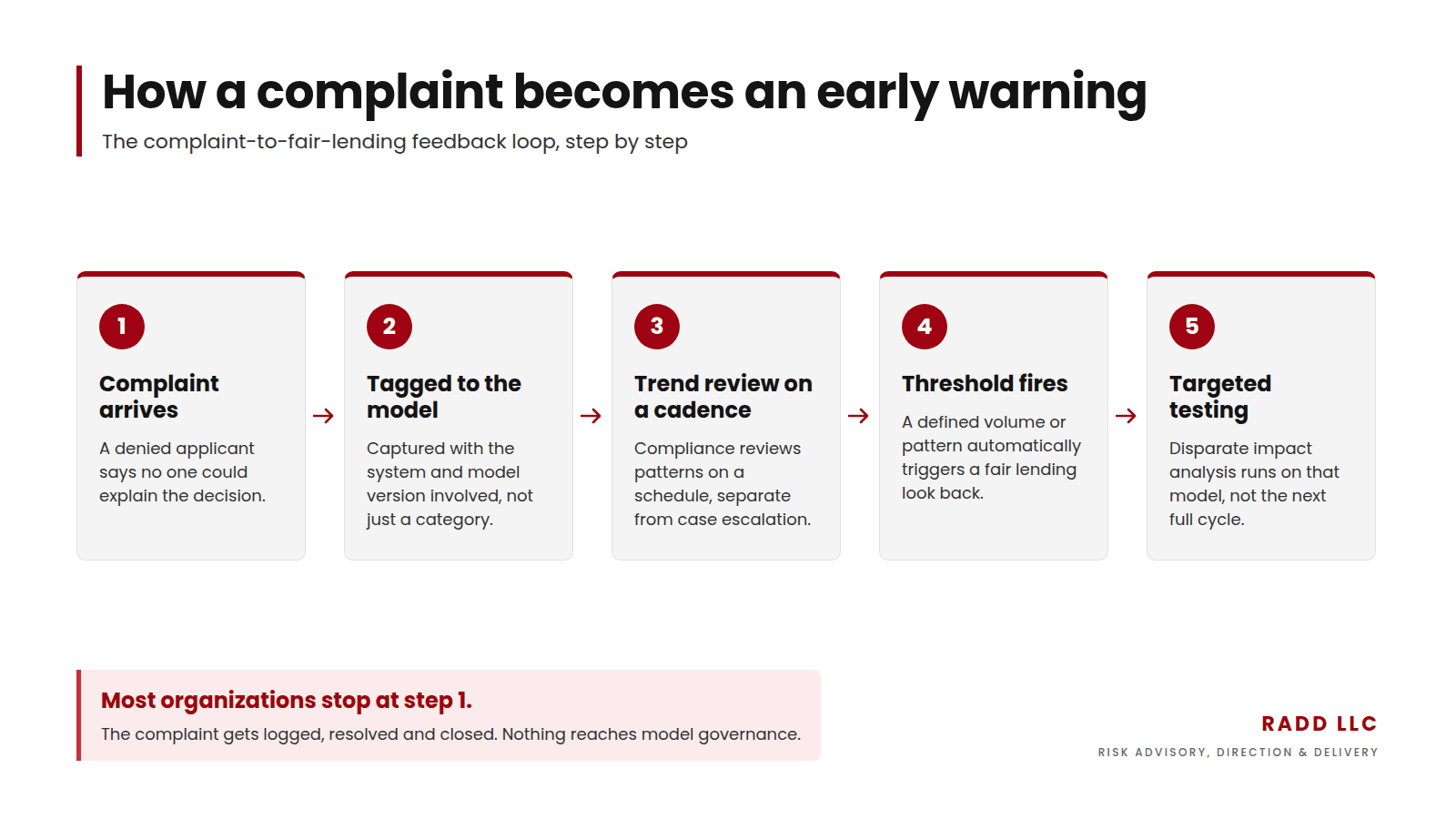
Tag complaints with model and system context. Capture which automated system, model version, or decisioning process was involved in a complaint, not just a general category. Without this, no one can connect a complaint trend back to a specific model in the first place.
Route relevant complaints to fair lending and compliance on a recurring basis. Individual complaints often get escalated only when they are severe. Trend level review needs its own recurring cadence, separate from case by case escalation, so patterns get seen even when no single complaint looks alarming.
Correlate complaint trends with quantitative fair lending testing. Use complaint clustering as a trigger for a targeted disparate impact analysis on the specific product, model, or channel involved, rather than waiting for the next scheduled testing cycle to catch it. Where a disparity holds up, the next question is whether a less discriminatory alternative exists.
Analyze complaint language, not just categories. Formal tagging structures will always miss some signal. A periodic qualitative review of complaint language, even a sample, can surface patterns that categorization alone will not capture.
Set thresholds that trigger review. Define in advance what volume or pattern of complaints tied to a given AI system should automatically prompt a fair lending look back, so the response does not depend on someone happening to notice.
Make complaint trend review part of AI model governance. Add it as a standing agenda item in model risk or fair lending committee meetings rather than treating it as a separate function that occasionally gets referenced. If complaint data lives outside model governance, it will keep getting missed no matter how well it is tagged.
What This Looks Like in Practice
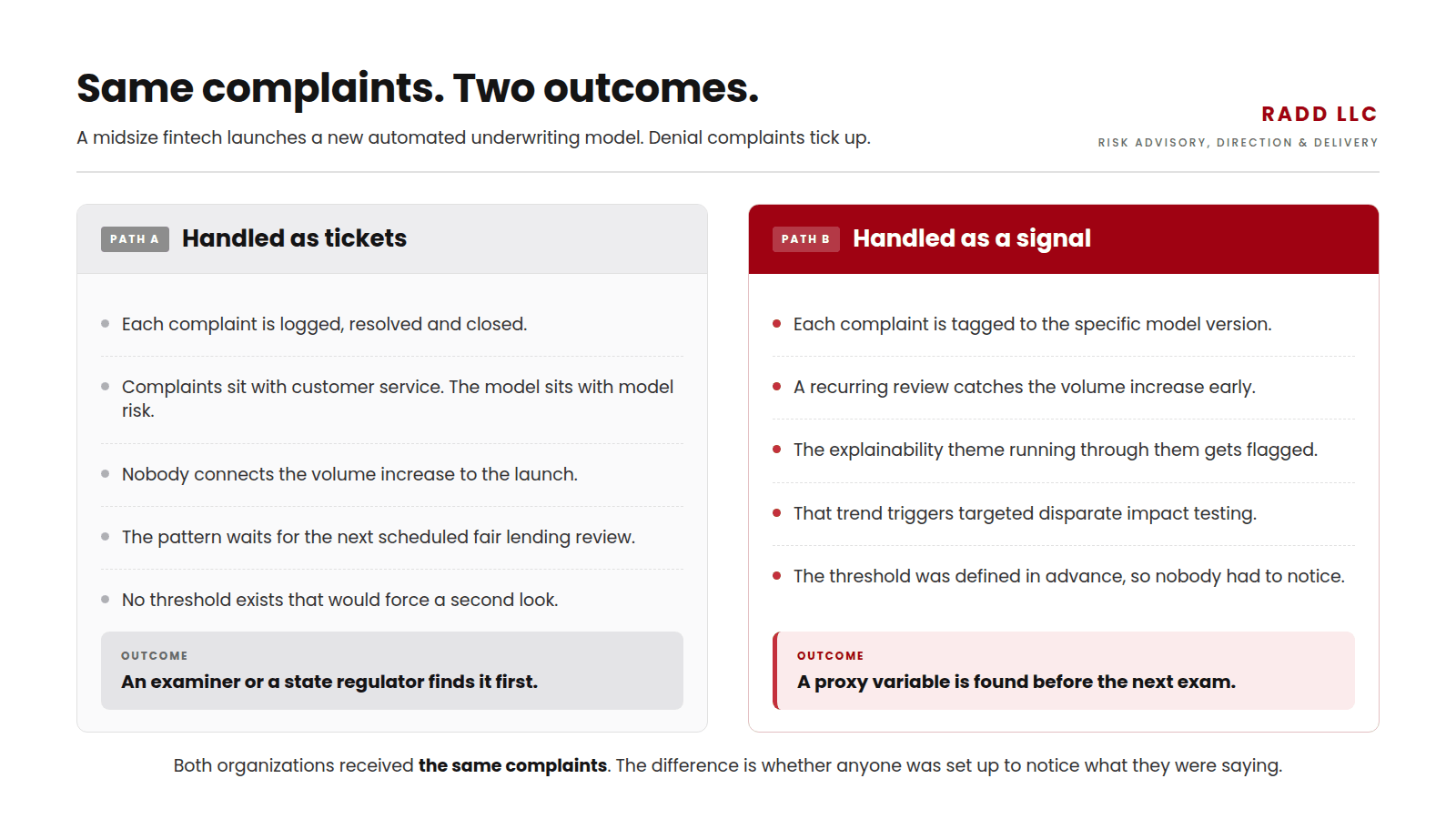
A midsize fintech launches a new automated underwriting model for personal loans. Within a few months, complaint volume tied to denials begins ticking up, though not dramatically, and not in a way that trips any existing alert. The complaints share a common thread: applicants saying no one could explain why they were denied, or that the reason given did not match what they understood about their own financial situation.
Handled the usual way, each complaint gets logged, resolved, and closed. Nobody connects the volume increase to the model launch, because complaints live with customer service and the model sits under a separate model risk function. The pattern holds until the next scheduled fair lending review, or until an examiner finds it first.
If the organization has built a feedback loop instead, the story looks different. Complaints are tagged to the specific model version. A recurring review catches the volume increase early and flags the explainability theme running through it. That trend triggers a targeted disparate impact analysis on the new model rather than waiting for the next full cycle. The analysis finds a proxy variable quietly correlating with a protected class, something the pre deployment testing did not catch because the applicant pool has shifted since launch.
The difference between these two outcomes is not the complaints themselves. Both organizations received the same complaints. The difference is whether anyone was set up to notice what those complaints were saying.
Frequently Asked Questions
Are consumer complaints considered part of fair lending risk management?
Yes, though many financial organizations do not treat them that way in practice. Complaint monitoring has long been expected as part of an effective compliance management system, and regulators increasingly expect that complaint data connects directly to fair lending oversight of AI models, not just general customer service resolution.
Can consumer complaints reveal AI bias before formal testing does?
Often, yes. Algorithmic bias tends to be statistical and diffuse, which means it can take time to surface in scheduled fair lending testing. Complaints capture the consumer experience in real time, so patterns like unexplained denials or inconsistent reasons can appear in complaint data well before a formal test cycle catches the same issue.
What kind of complaints should trigger a fair lending review?
Complaint volume that spikes around a specific product, model, or channel launch is one signal. So is language clustering around explainability, such as consumers saying they could not get a clear reason for a denial. Geographic or demographic clustering in complaints, and complaints tied to a specific automated touchpoint like a chatbot or automated adverse action notice, are also worth a closer look.
How should financial organizations tag complaints for fair lending purposes?
At minimum, complaints should be tagged with the specific model, model version, or automated system involved, not just a general complaint category. Without that level of detail, it becomes very difficult to connect a complaint trend back to a specific decisioning process later.
Does the CFPB require complaint monitoring for AI driven lending decisions?
Complaint monitoring has long been treated as a basic part of a sound compliance management system, and the duty to give specific, accurate adverse action reasons sits in ECOA and Regulation B, not in guidance that can be withdrawn. A financial organization that cannot explain a denial accurately is exposed under the law itself, and complaint data is often the first place that gap becomes visible.
Who should own complaint data related to AI fair lending risk?
In most organizations, complaints are owned by customer service or a dedicated complaints team, while fair lending sits with compliance or risk. Effective monitoring requires a defined connection between the two, typically through recurring trend reviews rather than one time escalation of individual complaints.
Does this apply to lenders that are not banks?
Yes. ECOA and Regulation B apply to any creditor, and the Fair Housing Act reaches mortgage lending regardless of charter.
The Bottom Line
Consumer complaints are one of the earliest and least expensive signals a financial organization has for catching AI driven fair lending risk before it becomes a formal finding. The data usually already exists. What is missing is the structure connecting it to fair lending risk management.
That gap carries real cost. A complaint pattern you miss is one regulators and state attorneys general can find instead, often through the same public channels open to consumers. Building the feedback loop answers a question examiners are already asking, before anyone has to ask it of you.
How RADD Can Help
You already collect the data. What is missing is the structure that connects it to fair lending risk early enough to matter.
Feedback loop design. We set up recurring review cycles that route complaint trends to your fair lending and compliance teams on a defined cadence, instead of ad hoc escalation.
Threshold and trigger development. We define what complaint volume or pattern around a given AI system should automatically prompt a fair lending review, so nobody has to guess when to act.
Targeted fair lending testing. When a trend surfaces, we run focused disparate impact analysis on the specific product, model, or channel involved rather than waiting for the next cycle.
Model governance integration. We build complaint trend review into your standing model risk and fair lending governance, so the data becomes a permanent input to AI oversight.
Start With the Data You Already Have
You do not need a new system to begin. You need someone to ask a fair lending question of the complaints you already have.
RADD’s fair lending audit services start exactly there. We review your complaint data against your model inventory, tell you which patterns warrant testing, and give you a written recommendation your board and your examiners can follow. If you are a fintech or a nonbank lender without a complaint to compliance loop yet, our fintech compliance services build one from scratch.
Get a quote and tell us what models you are running. We will tell you what your complaints are already saying about them.