
Internal Audit Outsourcing and Co Sourcing for Financial Institutions
Audits that land cleanly, boards that stay informed, and exams that hold no surprises.
What internal audit covers for a financial institution.
Internal audit is an independent, risk-based review of a financial institution’s controls, policies, and operations, testing whether what management says is happening is actually happening. For community banks, credit unions, and fintechs, internal audit typically covers BSA/AML, IT and cybersecurity, lending compliance, deposit compliance, vendor management, operations, and any business line that creates regulatory or reputational risk.
A well-run internal audit function gives the board, the audit committee, and examiners confidence that the institution is identifying its own risks before regulators do. A weak internal audit function does the opposite, findings stack up, exams get harder, and the audit committee starts asking management questions instead of approving management’s plan.
RADD’s internal audit services are built for institutions that need the depth of a national firm with the responsiveness of an in-house team, without adding permanent headcount.
What is internal audit outsourcing?
Internal audit outsourcing is when a bank, credit union, or fintech hires an outside firm to run all or part of its internal audit function. The firm plans the audits, does the testing, and reports the findings to the audit committee. The institution keeps responsibility for the function, and the outside firm supplies the people, the methodology, and the independence.
Co sourcing is the version where your institution keeps the audit plan and the outside firm covers the areas that need specialist skills, such as BSA AML, technology, or FDICIA testing. Full outsourcing hands the whole function over. Most community banks and credit unions land somewhere between the two.
What is internal audit co sourcing?
Internal audit co sourcing is a model where an institution keeps its own internal audit function and brings in an outside firm to work alongside it. The internal team keeps ownership of the plan and the relationship with the board. The outside firm supplies specialist skills, extra capacity, and independence on the work that needs it.
It sits between two other options. Full outsourcing hands the whole function to a firm. Staying in house means covering everything yourself. Co sourcing lets you keep control and still get coverage on the areas where your team is thin. It is the most common way RADD works with banks, credit unions, and fintechs.
Read more about internal audit co sourcing for banks and credit unions.

Your internal audit function is doing more with less every year.
You inherited a function that’s supposed to be the institution’s early warning system, but the work has multiplied faster than the team. BSA. IT and cyber. Fair lending. Vendor management. Fintech partnerships. Crypto exposure. ACH. CRA. CECL. Every quarter brings a new audit topic, a new examiner expectation, and a new gap that your team has to cover with the same headcount and the same budget.
You didn’t take this seat to spend your career chasing findings, defending the same gaps year after year, or hoping the next exam goes better than the last. You took it because you believe your institution deserves to grow, confident in front of regulators, trusted by the board, and free to focus on the work that actually moves the business forward.
What happens when internal audit falls behind.
- Ongoing findings and repeat issues that erode trust.
- Overworked teams and last-minute fire drills.
- Opportunity costs - missed growth, failed innovation, and frustrated leadership.
Audit problems don’t stay in the audit function. They show up in board packets, in exam letters, and eventually in the next MOU or consent order.
Why community banks and credit unions choose RADD for internal audit.
RADD was founded by a 30-year compliance veteran who spent decades inside financial institutions watching competent audit teams get stretched too thin to be proactive. He watched boards lose faith in their institution’s ability to spot problems before examiners did. The people responsible for protecting the institution’s reputation, heads of compliance, audit, and risk, were the ones absorbing the pressure.
Today, RADD is led by CEO Brian Montes, with a team of former senior auditors and examiners who have sat in your seat, and in the examiner’s. Our consultants average 25 years of industry experience. We hold the credentials examiners look for: CAMS, CIA, CISA, CRCM. We’re entirely U.S.-based, which means no offshoring, no outsourcing, and no rotating junior staff parachuting in for a sprint. And every engagement is built around the same outcome: clean audits, board confidence, and an internal audit function that can keep up with the next year’s workload.
- Your next audit?Clean, straightforward, and drama-free.
- Your Audit Committee?Satisfied. Your board? Fully trusting.
- Your team and C-suite?Aligned, less stressed, and future-ready.
- Your compliance journey?Clear, proactive, and always a step ahead.

Your internal audit plan: the R.A.D.D. Compliance Confidence Framework™
You shouldn’t have to figure out where to start. Our four-step framework turns audit uncertainty into a clear path forward, built around your institution’s size, business lines, and risk profile.

Reveal Risks
We uncover the audit gaps, control weaknesses, and emerging risk exposures specific to your institution, before an examiner finds them first.

Align & Analyze
We benchmark your audit coverage against examiner expectations and board priorities, including BSA, IT, fair lending, fintech partnerships, IT compliance, crypto, and privacy laws (CCPA/GLBA).

Design Your Audit Roadmap
You get a customized, board-ready internal audit plan with priorities, timelines, scope, and resource recommendations, calibrated to your risk profile, not a generic checklist.
Deliver & Defend
We execute the audit plan alongside your team, through scoped engagements or our RADD Assist subscription, and stand with you in front of examiners, the audit committee, and the board.








What our internal audit services cover.
You don’t need ten different vendors for ten different audit topics. RADD provides the full risk picture for community banks, credit unions, fintechs, and crypto-enabled institutions under one engagement.
- Accounting / Finance Services
- ACH Annual Certification and Self-Assessment
- ALLL / CECL
- Branch Site Reviews
- BSA Model Validation
- BSA / AML / OFAC Program Review
- Business Continuity (BCP) Testing
- Cannabis Banking Model Validation
- Central Operations & Internal Controls
- Community Reinvestment Act (CRA)
- Compliance Management Program
- Deposit Compliance
- Electronic Banking / Treasury Management
- Enforcement Action Remediation
- GLBA / CCPA Compliance Testing
- Human Resources
- Information Technology and Security
- IRR / Liquidity / Investments, Back Testing
- Lending Compliance
- Loan File Review
- Mortgage Quality Control (MERS)
- MRB / CRB Model Validation
- Note / Loan Operations
- Remote Deposit Capture / Mobile Capture
- Social Engineering
- SOX Testing
- Vendor Management
- Vulnerability Assessments and Penetration Testing
- Website / ADA Compliance
- Wire Transfers / Funds Transfers
Outsourced, co-sourced, or in-house internal audit, which is right for your institution?
Most community banks, credit unions, and fintechs don’t have the budget or volume to staff a full in-house internal audit team. The realistic choice is between three engagement models.
In-house internal audit
You hire and manage the full audit function internally. Best for institutions $1B+ in assets with consistent audit volume, complex business lines, and the budget to fund a Chief Audit Executive plus 3+ auditors. Pros: deep institutional knowledge. Cons: hardest to maintain independence, expensive in fully-loaded cost, hardest to keep credentials current across all audit topics.
Co-sourced internal audit (RADD’s most common engagement)
Your institution keeps a small internal audit function (often 1 to 2 people) and brings RADD in for the audit topics that require specialized expertise, IT, BSA, fintech, crypto, model validation, enforcement action remediation. Best for community banks and credit unions $250M, $5B. Pros: lower fully-loaded cost than in-house, independence on specialized topics, credentialed coverage of every audit area. Cons: requires strong internal audit leadership to coordinate.
Fully outsourced internal audit
RADD owns the entire audit function, building the annual plan, executing every audit, reporting to the audit committee. Best for smaller community banks and de novo fintechs that don’t yet have an internal audit budget. Pros: lowest cost to start, full credentialed coverage, examiner-tested deliverables. Cons: relies on the firm’s responsiveness for in-cycle questions.
If you’re not sure which model is right for your institution, that’s exactly what our compliance assessment is designed to figure out.
Three ways to work with RADD on internal audit.
Option 1: One-time scoped audit
Best for a single high-priority area, a BSA model validation, an IT audit, a CRA review, an enforcement action remediation. Fixed scope, fixed fee, defined deliverables.
Option 2: Annual internal audit plan
RADD builds and executes your full risk-based audit schedule for the year. The audit committee approves the plan in Q1; we deliver findings, management responses, and board reports throughout. Repeatable, predictable, exam-ready.
Option 3: RADD Assist subscription
A monthly retainer that gives you ongoing access to our auditors, for audit work, advisory, exam prep, and the questions that come up between scheduled audits. Best for institutions that want a co-source model without the cost of a full in-house team.
What audit leaders say about RADD.
“Anyone looking for a great audit company should consider RADD. Radhika and her team of audit pros are great to work with, super thorough, and cost efficient. I’ve enjoyed working with the team through audits in 2020 and our Supervisory Committee appreciates the report quality. I highly recommend this group.”
, VP, Enterprise Risk Management
Credit Union, Southern California
“Over the course of the year with us, she brought our programs current and in compliance with current regulations… As a result, we successfully passed our Safety and Soundness exam and the EIC specifically commented on the work performed by RADD LLC. Radhika and her team are very knowledgeable in all aspects of compliance, I highly recommend RADD LLC for any project, regardless of size.”
, Director of Operations
$300M Bank, Southern California
Not ready for a quote? Stay ahead of your next audit.
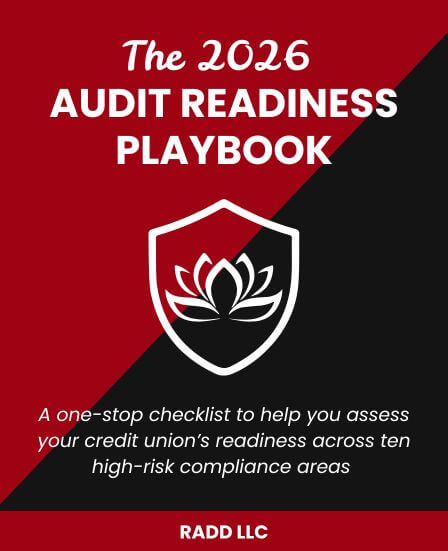
Download The 2026 Audit Readiness Playbook, Free.
Regulatory pressure isn’t slowing down. The 2026 Audit Readiness Playbook is a one-stop checklist that helps risk, compliance, and audit leaders quickly identify gaps before examiners do, across the ten high-risk compliance areas your audit committee and examiners care about most.
What’s inside: Governance and Board Oversight, Culture of Compliance, Risk Assessments, Consumer Protection and Fair Lending, Artificial Intelligence and Algorithmic Governance, Cybersecurity and Data Privacy, Third-Party Risk Management, BSA/AML/OFAC Controls, Internal Audit and Monitoring, and Training and Regulatory Change Management.
- A checklist of key areas examiners are likely to scrutinize in the coming year (based on the latest regulatory trends)
- Sample internal audit calendar templates to organize your compliance efforts
- Tips for getting results - even if your team is running lean
- Quick wins for reducing audit risk and impressing your board
Internal audit FAQs, what financial institutions ask us most.
What is internal audit, and how is it different from external audit?
Internal audit is an independent, risk-based review of an institution’s controls, policies, and operations, performed for the institution to identify issues before regulators or external auditors do. External audit is performed for third parties (regulators, shareholders) to validate financial statements. Internal audit covers a much broader scope (BSA, IT, lending, operations, vendor management) and reports to the audit committee. External audit focuses primarily on the accuracy of the financial statements.
Does a small community bank or credit union really need a formal internal audit function?
Yes. Federal banking regulators (FDIC, OCC, NCUA) expect every institution to maintain an internal audit function appropriate to its size, complexity, and risk profile. For institutions under $1B in assets, that usually means a co-sourced or fully outsourced model, but the requirement and the examiner expectation are the same.
What’s a risk-based internal audit plan?
A risk-based internal audit plan prioritizes audit topics by the actual risk they pose to the institution, instead of running the same generic schedule every year. The plan starts with a risk assessment, which business lines, controls, and regulatory areas are highest-risk, and allocates audit hours accordingly. This is what examiners, FFIEC, and NCUA want to see.
What does an internal audit engagement with RADD cost?
Engagement cost depends on scope, institution size, and topic complexity. A single scoped audit, a full annual internal audit plan, and a RADD Assist monthly subscription each price differently. We provide a fixed-fee quote after a no-cost scoping conversation so you know the total cost before the engagement starts.
How long does a typical internal audit engagement take?
A scoped single-topic audit usually takes 4 to 8 weeks from kickoff to final report. A full annual audit plan runs across the full calendar year, with audit committee deliverables at each quarter. RADD Assist is ongoing.
Can RADD co-source with our existing internal audit team?
Yes. Co-sourced engagements are RADD’s most common model for community banks and credit unions $250M, $5B. Your team owns the function; we deliver the topics that need specialized expertise (IT, BSA, fintech, crypto, model validation, enforcement remediation).
Does RADD audit fintechs and crypto-enabled institutions?
Yes. RADD audits fintechs (including BaaS and embedded-finance platforms) and crypto-enabled financial institutions (including MRB and digital-asset banking programs). Our consultants have specific experience with the regulatory expectations FinCEN, FFIEC, and the prudential regulators apply to these business models.
Where is RADD based?
RADD is based in Long Beach, California, with a 100% U.S.-based team. We serve community banks, credit unions, and fintechs nationwide. No offshoring, no outsourcing.
Talk with us about your internal audit needs.
If you’re building next year’s audit plan, rebuilding after an enforcement action, or trying to get ahead of what’s coming next, let’s talk. We’ll show you what a clean audit, a confident board, and an exam-ready internal audit function look like for your institution.

Reviewed by Brian Montes, CEO, RADD LLC. Brian leads a team of former senior compliance leaders and examiners credentialed across CAMS, CIA, CISA, and CRCM, serving community banks, credit unions, and fintechs since 2019. Learn more about our team →